 Photojournalism is the effort to communicate news through the use of photographs. Photojournalism first began in the United States during the Civil War. Matthew Brady worked for Harpers Weekly magazine and photographed soldiers and battlefields for the publication.
In 1889 a Danish immigrant, Jacob Riis, wrote an article for Scribner magazine which featured his photos of New York City slums. Riis then went on to produce a book based upon his photos called, “How the Other Half Lives: Studies among the Tenements of New York”. This book explained the living conditions for thousands of immigrants who were living in city slums and working in sweatshops for a few cents a day. Riis’s photojournalism was credited with improving living and working conditions in New York City. Theodore Roosevelt called Riis “the most useful citizen of New York.”
In the late 1800’s newspaper, magazine and book publishers were recognizing the value of including images with news stories. It was in this setting that Brattleboro would emerge as the place that gave one of the first female photojournalists her big break.
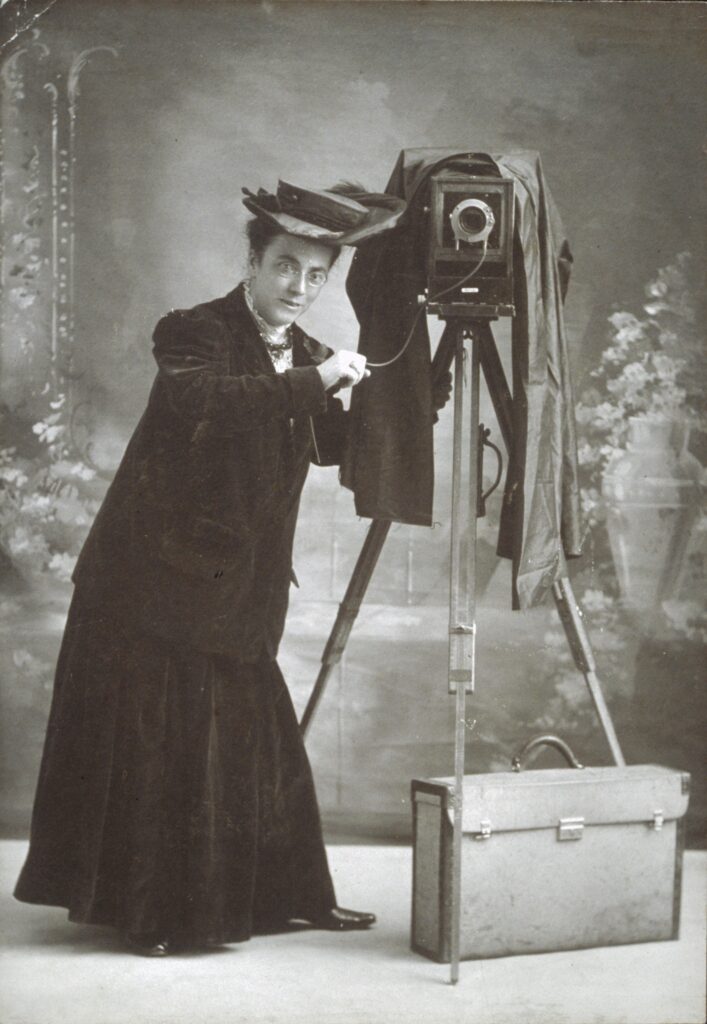
Jessie Tarbox Beals was from Greenfield, Massachusetts. In 1900 Jessie was 30 years old and looking for a change. Twelve years earlier she had won a camera in a magazine contest and had been improving her photography skills since then. As the new century began she decided to change careers. She convinced her husband that they should become itinerant photographers and travel the country. Jessie taught her husband, Alfred, the basics of photograph development and they began on a new adventure.
Jessie took the photographs and managed business matters while Alfred was in charge of the portable darkroom and handled the processing of negative plates and prints. In September, 1900 they began their new business venture in Brattleboro. They traveled the twenty miles north on the train and arrived in town with the idea of photographing the Valley Fair.
In 1900 the Vermont Phoenix called the two day Valley Fair “Our Annual Triumph!”. Over 18,000 people attended the fair at the present location of Brattleboro Union High School. Two of those in attendance were Jessie and Alfred Beals. Jessie kept a diary and recorded her thoughts about her experiences in Brattleboro.
“September 26, 1900… Hurrah for freedom and for Brattleboro!…found a good boarding place where we are dwelling in peace and plenty… I hunted up editors to inveigle them into buying my photos, yet to be taken, and saw a bookstore man who is to put my parade photos for sale… then we hired our way to the Fair Grounds to find a place to set up our portable darkroom. Found what we wanted in one of the horse stables, all clean and sweet with a thick layer of fresh straw covering the ground.”
“September 29, 1900… The next two days were too busy to be described. Taking pictures from 9:30 to 10:30 when the parade started. Then we went up to the Fair Grounds and took pictures of some floats, rushing back to work in our darkroom developing and printing… The afternoon of the parade Allie carried a full set of the photos to put in Mrs. Geddes’ window down the street. It was a mystery to the good people of Brattleboro how he got them finished up so soon… The Editor of one paper and the reporter of another kept us busy getting out prints for them: six for the Reformer and three for the Phoenix.”
The photographs in the Phoenix were published without a credit to the photographer. The Windham County Reformer credited “Mrs. Beals of Greenfield, Mass.” with the photographs published in the paper. According to anthropologist Alexander Alland Sr., this means Jessie Tarbox Beals was the world’s first recorded woman news photographer.
After the Valley Fair was over the Beals chose to remain in Brattleboro until Thanksgiving. They exhibited photos from the fair and also displayed images of birds that Jessie had taken previously. Alfred had been extremely efficient in processing the images that Jessie had taken during the fair. Word spread in Brattleboro that the female photographer took good photos and was quick to produce prints of her work. Jessie decided to build on this good will and go door to door to see if people would like to have their photos taken. She rode her bicycle around town looking for work. Here’s what she wrote in her diary…
“The characters I meet in my canvassing! Jolly old Irishmen and women with their rich brogue and their ‘God Bless You’s’. Yellow-haired, round-faced Swedes, black-eyed gesturing French, all with their unmistakable characteristics. Everyone seems interested in my samples, without hesitation leaving their babies, dishes or washtubs to inspect them… I receive unfailing courtesy from the foreigners. The only unfriendly answers I received were from the Yankees, people a bit high in their feelings… The past week has been booming-16 to 20 pictures taken daily. Poor Beals is kept busy developing and printing… Saturday I took photos at the canning factory about 1 ½ miles away. At noon brought the plates home. Allie developed them, I got the proofs to them at 5. Were they surprised! Took orders for 45 prints… I’m going to try more of the factories and shops this week as there is money in that class of work….An Irishwoman said to me, ‘For God’s sake lady, ain’t you a hustler to be riding around with all that truck on your wheels.’ Said truck being camera bags, samples, tripod, all weighing about 16 pounds.”
On October 12, 1900 the local newspaper reported, “Mr. and Mrs. Alfred Beals of Greenfield, who have been in Brattleboro the past few weeks, will spend a large part of the winter in Southern California. The pictures of the Valley Fair coaching parade made by Mr. and Mrs. Beals have found ready sale.”
Jessie wrote in her diary, “Every day I’m stopped on the street about the pictures…’ There is our lady on the bicycle. There is the picture taken lady.’… Our abiding place in Brattleboro is a big farmhouse. Mrs. Curtis is our landlady, we are rooming on the upper floor…A good locality for my work has been Swedeville, an interesting part of town. The Swedes are very clannish, they hold together. Almost all the families there are related: Johnsons, Magnusons, Carlsons, etc… The weather has been lovely, rather warm and pleasant, then came the first fall of snow. The 24th of November it snowed all day, so it’s about time we went south. Next Monday will be our last day here… If we could have stayed in town longer business would have been good, but the roads became poor, making our going on our wheels difficult…”
After Thanksgiving Jessie and her husband, Alfred, left by train for New York City, on their way to Florida. As itinerant photographers they traveled to find work. During the following year they found themselves in Buffalo, New York and Jessie took a job as staff photographer for the Buffalo Inquirer and the Buffalo Courier newspapers. This position cemented the claim that she was the first female photojournalist in the United States, having begun her career here in Brattleboro. Unfortunately, we are not aware of any Brattleboro photos taken by Jessie Beals that exist today.
Information for this story was found in a 1978 publication for the Camera Graphic Press, “Jessie Tarbox Beals, First Woman News Photographer”, by Alexander Alland, Senior.