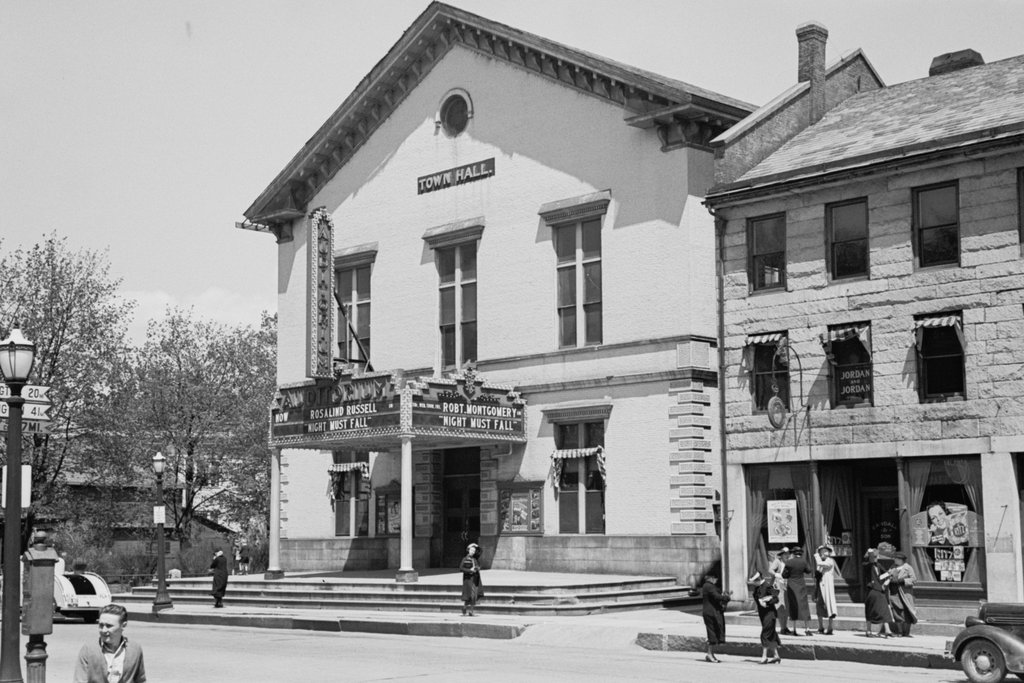
A little over seventy years ago, UVM Professor Leon Dean offered a course in “Vermont History and Folklore”. The course was designed for local teachers and met for fifteen weeks. It was offered through the University of Vermont Extension Service. Teachers could earn two hours of college credit. People from the community were also able to enroll in the local history class. The course was held in the evenings at the Powers House on Green Street, next to the elementary school. At the time, Powers House also served as the Superintendent’s office.
A product of the course was a booklet of articles researched and written by the class attendees. The publication was called “Bridge To Yesteryear: Vermont Folklore Articles” and contained fifty pages of stories by twenty four authors. One of the articles was written by Ruth Atkinson, a local junior high science teacher. Here is her 1951 article, “Brattleboro Trees”.
“In the beginning there were trees. So many were here, that the dense shade cast by their interlacing needles caused a similar gloom in the hearts of the early European settlers. Royal authority forbade cutting of the trees without license but, on the other hand, the lands were granted on condition that three acres of every fifty should be cultivated.
What to do! A very early settler, Ebenezer Fisher of Brattleboro, was arrested for felling white pines which he swore had been dead before he had taken up the land. He had moved to the area in 1766 when there were only fourteen English-speaking families in town. Settlers were not allowed to cut down large white pines that could be used for British shipbuilding.
It was all well, however, that every tree was not felled. Mrs. Sarah Dunklee, wife of Jonathan, while on horseback journey near the settlement on Meetinghouse Hill, was chased by wolves. The Dunklees had moved to Brattleboro in 1774. She escaped by climbing on the branches of a tree for safety. The horse returned home and, fortunately, her family came to the rescue.
Diligently and ruthlessly were the primeval pines felled; for letting in sunlight, for cabin logs, for fuel, and for British masts. By 1800, the town was well-nigh denuded of shade trees except for a few stragglers. The Merino sheep mania, beginning in the first quarter of the 1800’s, continued the demise of many trees, as wooded hillsides were turned into grazing pastures.
At last, some beauty-loving citizens decided that Brattleboro needed shade trees. The wealthier second and third generations scorned native trees and planted Lombardy poplars, originally from Europe, Africa and Asia. This tree grew quickly and soon the whole town, including Main Street, marched with these narrow spires. Old residents on Cemetery Hill were heard to remark that Brattleboro from above resembled a child’s toy village with the orderly rows of tall, slim trees towering over modest houses.
After the poplar craze came the sycamore period. In the mid-1800’s this rather ungainly tree was planted along the village streets. Today only an occasional one remains along a brook or in the yard of an old home.
At all times there were oaks, but not in great numbers. The best known stand of oak trees was the old grove on the Goodhue property, which is now the rectangular section of town within Grove Street, Oak Street and High Street. The grove covered a gentle slope from the level of Main Street up to the top of High Street’s first rise.
Before commercial buildings rose below it, this was a popular place for picnics. It was there, in 1840, that Daniel Webster spoke. It is extremely sad to report that recently the last of these magnificent trees have been cut down.
As in many New England towns, the elm is the most common shade tree in Brattleboro. Although elms may live two hundred years, the majority of Brattleboro elms are not over a century old, and many are less than that. A considerable planting of elms took place right after the Civil War.
The last popular tree planting has been maple. Having experimented with importations from around the world, the town now acknowledges Vermont’s characteristic tree. There are so many of them that many streets have a vaulted roof of shade, particularly beautiful when the leaves assume autumn colors.”
Since Mrs. Atkinson’s article in the 1950’s, elms have been demolished by Dutch Elm Disease, and the tall, stately trees have disappeared from most New England towns.
Ruth Anderson graduated from UVM and moved to Brattleboro to teach at Academy School. In 1921 she married John Atkinson. Ruth left teaching to raise their two children and returned to teaching in 1942. Her husband, John, was a World War I veteran and local mail carrier. Their home was on Greenleaf Street.
Ruth lived to be 64 years old. At the time of her death she was teaching junior high science at the newly opened Brattleboro High School on Fairground Road. She finished her classes on a crisp fall day and drove home. It was a late October afternoon and, for the most part, only the oak leaves were clinging to the trees. Shortly after arriving home she experienced a heart attack and, according to her obituary, succumbed almost immediately.
By that time of the year the maple, birch, and many of the beech trees had let go of their leaves. The hill just up from her house was full of native trees, including large pines that may have qualified for the British King’s Navy… if they had been around 200 years earlier.