For many years there was a tradition at Brattleboro High School which included the reading of student essays during commencement ceremonies. All twelfth graders were expected to research and write an essay as part of their senior program. Top essays were chosen by faculty and their authors read the essays to the assembled audience at graduation exercises.
At the 1951 graduation ceremony Florence Anderson’s essay was the first featured reading. Florence enjoyed singing and researched a local hero of hers, internationally-renowned singer Mary Howe. Here is an excerpt from her essay…
“The heading, ‘local girl who made good,’ could be attributed to the operatic soprano, Mary Howe, as she pursued her musical career on the concert stages of Europe just before the turn of the century. This local star was born in 1867. Her musical talent showed itself in her earliest childhood and had the advantage of careful training from the first. Her father and mother were both singers. Caleb Howe, a photographer by profession and a marvelous tenor voice not only sang in church and concerts but taught in old-time singing schools. Her brother, Lucien, was a student of music and a composer of several works for the piano. From him Mary received instruction in piano, and he took a great interest in her training by directing her music education with the greatest care.
In the family home on Harris Place all were musical and the works of the best composers were played and sung. Mary learned her music lessons in this family atmosphere. The music-loving people of Brattleboro very early became acquainted with her singing in various operettas and concerts in which she took a leading part.
Mary Howe’s participation in musical activity began early. Her first effort in the dramatic line was made when she was ten years old. She took the part of Josephine in a performance of H.M.S. Pinafore given by a group of young people. When she was sixteen she went with her brother, Lucien, to Boston where, during two winters, she received vocal lessons from Charles Adams; later she visited Philadelphia to continue her studies with special emphasis on an operatic career.
In 1886 Mary sailed for Europe with Lucien and her mother to complete her preparation for the operatic stage. She at once attracted the attention of the people of Dresden, Germany, by the unusual beauty of her voice, and the critics hailed her as ‘a star of first magnitude’. The following autumn she gave her first public concert before an audience filling every corner of the concert hall in Dresden.
Engagements now really began. After singing repeatedly in other German cities, she agreed to make sixteen appearances at Kroll’s of Berlin, a theater where many celebrated singers have been introduced to fame and fortune. Her operatic debut was a brilliant success.
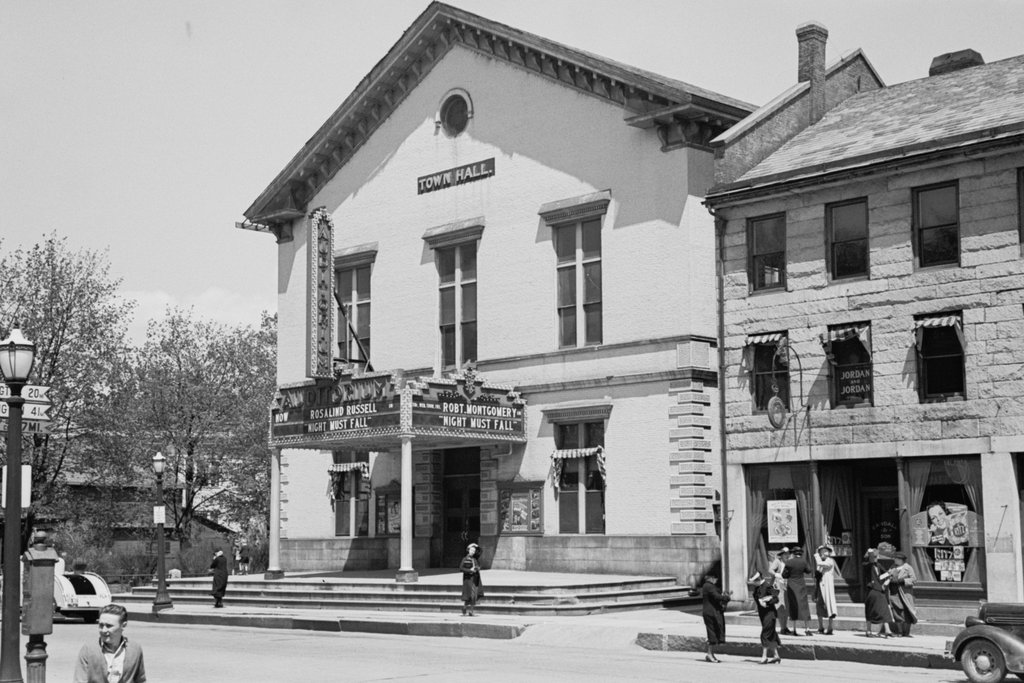
Mary returned on a visit to her native country arriving with Lucien and her mother on July 25, 1888. On August 17, when she was only nineteen years old, she made her American debut here at our own Town Hall at the request of the townspeople.
It was a memorable occasion. Under the direction of Professor Christian J. Shuster of Greenfield, the Philharmonic Society played during the concert. As people studied their programs, a sudden demonstration on the part of the audience was noted. As they glanced hastily towards the beautifully decorated stage, they could see Mr. Lucien Howe escorting his sister, who, as soon as quiet was restored, broke forth in divine melody, ‘Be it ever so humble’, she sang with deep feeling, ‘there’s no place like home.’ This was too much. Listeners stealthily brushed away a tear and wondered about the person to whom they were indebted for this lovely surprise.
The program was a successful one. Mary had no difficulty in the way of execution. She poised her voice like a bird on the high notes, and tripped delicately but fully up and down the most rapid staccato passages until the audience could contain their enthusiasm no longer and broke forth in a sudden and deafening applause.
The peculiar beauty of Mary’s voice lay in its golden purity. The program of that evening also brought forth the technical certainty and fineness of her execution-the accomplishment of her European training.”
In 1901 the St. Albans Messenger wrote this about Mary Howe… ”Mary Howe is an eminent example of what a talented girl with grit and determination can accomplish. A dozen years ago the world first heard of her upon her debut at the age of 19 years in a grand opera in Berlin, but previous to that triumph she had sung her way into the hearts of Vermonters. She began to sing as soon as she began to walk, and all through her school days in the public schools her soprano voice was the wonder and admiration of teachers and friends.
The cultivation of her voice began early and while in her teens she was sent to Paris, for a course of study. Later she went to Dresden and studied under other celebrated teachers. While abroad, accompanied by her brother Lucien, Miss Howe devoted herself heart and soul to her work, completely mastering the French, Italian and German tongues and acquiring the extensive repertory of grand operas which have any degree of popularity. To this great task, involving the most rigorous study, she brought the intelligence, pluck, and resolution characteristic of the girls raised on the rugged hillsides of Vermont.
But how splendidly she conquered was evidenced by the ovations she received upon her appearance in this country in the season of 1891-92. Many will remember how audiences went completely crazy over her. One extract from the New York Sun will show the excitement caused by her appearance. The Sun said, ‘Seldom has there appeared upon the concert or operatic stage a woman of such superb physique and beauty as that with which Miss Howe is gifted. If she merely stands before her audience it is at once strongly predisposed in her favor. Add to this a voice of natural excellence and abnormal extension in its upper register which has been cultivated with clever artifice and evident patience and assiduous care, we have an artist richly equipped as an ornament to any concert room.’
In Germany, where Mary Howe has sung almost exclusively in grand opera, she has become known as the ‘American Nightingale’. Among her triumphs abroad perhaps the most distinguished was her appearance by special request before Kaiser Wilhelm of Germany in the Barber of Seville. At the close of her singing Miss Howe was personally complimented in the most enthusiastic manner by the Kaiser.”
In 1891 Mary married a singer she had met while touring New England and Europe, William Lavin. They had known one another for three years and were married while both were on tour in Cleveland, Ohio. The couple remained together until 1900 and then divorced. Mary often spent opera seasons in Germany while William performed in England. When Mary was not on tour she preferred to live with her widowed mother in Brattleboro. Mary’s mother, Martha Howe, died in 1901.
Florence Anderson’s graduation essay closed with these words, “On October 24, 1905, Mary’s marriage to Edward Burton of Lancaster, Massachusetts took place. She then abandoned the stage, but her voice, when heard again in church and occasional concerts for charitable objects, indicated a progress derived from further study and from the influences of life’s experience.
Mary Howe’s life reflects the success of many small-town citizens who have been willing to work to achieve a bright future. She chose music as her career and dedicated her life to that end. Her successful life is one which should be remembered by those who will soon be seeking a secure and happy one of their own.”