In April, 1772, Stephen Greenleaf was appointed Justice of the Peace for Cumberland County in the Province of New York. He had recently moved from Boston with his family and purchased 800 acres of land and a saw mill from Samuel Wells. The 800 acres would become the most valuable land in Brattleboro, but 250 years ago the two room home that the Greenleaf family moved into was the only building in the area now known as Main Street.
The 800 acres purchased from Wells had originally been the land set aside for New Hampshire’s Governor Wentworth when the town was chartered in 1753. In 1766, after the King of England had declared that Brattleboro was really a part of the province of New York, Samuel Wells traveled to Albany and obtained New York title to the land.
In the 1770’s the Great River Road, now Main Street, ran from Fort Dummer to the Wells Tavern, now Retreat Farm. According to Greenleaf’s son, when the family of eight moved into the house, “our mother was then the only woman residing within a mile of our dwelling, and not more than twenty families inhabited the whole town.” The Greenleaf’s lived in one of the rooms of the house and Stephen opened what was said to be “the first store of goods” in Vermont in the other room.
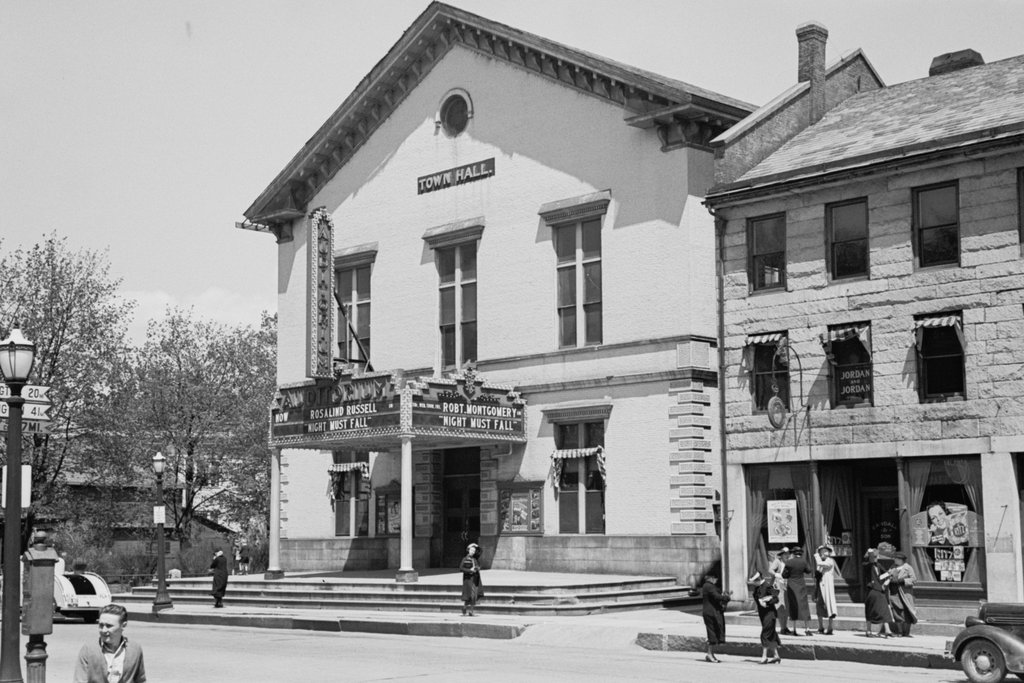
Greenleaf’s family had moved to town in 1770 and lived near the corner of what is now Old Guilford Road and Sunny Acres in southeastern Brattleboro. He purchased the 800 acres from Wells and built his home/store on the bank overlooking the Connecticut River. The building was located where Union Block presently stands on the east side of Main Street.
Greenleaf had been a merchant in Boston. He was an importer of English goods and had fallen into debt. He came to Brattleboro to leave his misfortune behind and begin again. The 800 acres he purchased from Wells was bought with borrowed money. He built his home/store and operated the saw mill along the Whetstone Brook. He cleared and farmed his land as best he could. A goat pasture was established where the train station now stands and Greenleaf also built a gristmill on the north side of the Whetstone Brook.
Later in life Stephen Greenleaf’s son wrote about his time growing up in the area that would become Main Street. “I so often perambulated in the days of my youth, hunting for game, or looking for the cow in the fenceless pasture, the forests, accompanied by two favorite companions, my dog and my gun, alternately looking and listening for the bounding of the rabbit, the start of the squirrel, the drumming of the partridge, and the tinkling of the cow bell, at the same time suffering from gnats and mosquitos. At that time I assisted in toppling the forest and clearing the soil of its encumbrances; that soil which now sustains the east village of Brattleboro.”
In the 1770’s Brattleboro was a town of contradictions. Some people, like Samuel Wells, were loyal to the King of England and wanted the colonies to remain a part of Great Britain. Others supported the colonial rebels who wanted to break free of England and gain their independence. In 1775 colonial rebels known as Minutemen fought against the British army at Lexington and Concord. Greenleaf promised to send 20 bushels of wheat from his grist mill to help feed the rebels of Massachusetts.
In late April, 1777, Stephen Greenleaf was working with other men to plant corn at the place now known as the Retreat Meadows. He was forty two years old and, with his eldest son, was preparing the fields for one of the earliest planting seasons in memory. The Revolutionary War had been raging in New England for a few years but it had yet to make its way directly into Vermont.
This was about to change. The war had seemed far away, taking place around Boston and on the other side of the mountains in New York. More pressing had been the controversy of whether to accept the efforts of other towns in the region to form an independent republic. A convention of representatives from more than twenty towns met in Windsor earlier in the year and voted to declare their independence. These towns voted to form their own government and become free from New York governmental supervision.
Brattleboro had not participated in the convention and at an April 25th Town Meeting voted not to recognize the newly declared government. A committee was formed to reach out to other towns in hopes of building opposition to this newly formed republic. Greenleaf was a member of this committee created to oppose the establishment of Vermont. He had also been chosen to serve as Brattleboro town clerk and remained loyal to the New York government structure.
It was in this setting that word reached town about the advance of British troops into the region. According to Greenleaf’s son, “the enemy were on the march from Canada, and other towns were mustering troops to march on the occasion.” British General Burgoyne had ordered Colonel Baum to advance troops down Lake Champlain and it was believed his army would travel over the Green Mountains to Charlestown, NH and then continue south to Brattleboro on the way to Boston, Massachusetts.
A few days after Greenleaf had been selected to represent Brattleboro in its opposition to a newly formed Vermont a man from the local militia appeared at the corn meadow and drafted Greenleaf into service. The local militia intended to defend the region from British attack. Greenleaf was 42 years old and did not feel fit enough to serve. His son, Stephen Jr., was 18 years old and volunteered to take his place.
Early in his service young Greenleaf marched over the mountains to Rutland. The militia’s goal was to intercept Baum’s army as it began its advance towards Boston. However, Baum’s army skirmished with Colonel Seth Warner’s troops in Hubbardton, Vt. and then continued south through New York. It emerged that the British were not looking to travel to Boston, but planned to advance down the Hudson River towards New York City.
The Brattleboro militia returned to town and was then quickly called out again to join General John Stark’s troops in Bennington. They arrived a day after the Battle of Bennington occurred and were ordered to guard a military outpost near White Creek, New York. After a few weeks they were sent home but were only back a few days when they were called again to march for Saratoga, New York.
This time the local militia was attached to the Continental Army and commanded first by Colonel Rensselaer and later, Colonel Morgan. Young Greenleaf reported that he served with “several other Green Mountain Boys-the draft was made in Dummerston as well as in Brattleboro”. The local militia remained through the surrender of British General Burgoyne in mid-October, 1777. Many historians consider the British surrender at Saratoga as the turning point of the American Revolution. As a result, the French agreed to enter into the war on the American side and Great Britain was forced to divert some of its resources to conflicts in other parts of the world. Young Greenleaf reported that approximately twenty Brattleboro men served on the American side during the Revolution.
Stephen Greenleaf, the father, would go on to serve Brattleboro as town clerk while the political winds shifted and the town switched allegiance, finally agreeing to recognize the Vermont government in 1784. Greenleaf continued to struggle financially. Despite operating a grist mill, saw mill and farm he was unable to keep up with his debts. At the time of his death in 1802 Greenleaf owned only six of the 800 acres he began with thirty years earlier. In terms of his personal life, however, he had prospered. He and his wife had eleven children. Each of them survived to adulthood. The boys became sailors, writers and doctors. The daughters married and raised many children of their own. Young Stephen Greenleaf became a carpenter and served 45 years as Brattleboro town clerk.
It is not clear whether young Greenleaf was really at the Battle of Saratoga. Later in life he applied for a military pension but was denied as he couldn’t provide specific dates of service. In order to receive a pension soldiers needed to prove that they had served at least six months in the war.
Stephen Greenleaf Jr. returned home after the war and became a carpenter and wheelwright. On his way back from Saratoga he claimed to have walked through the Bennington Battlefield in New York. He picked up a few small cannon balls and they are now in the Brattleboro Historical Society collection.
Southeastern Vermont was outside the field of action of the Revolutionary forces but not outside of the intentions of the British commander as General Burgoyne ordered Colonel Baum to “proceed from Batten Kill to Arlington…and then proceed to Manchester,…you will proceed by the road over the mountains to Rockingham…you are afterwards to descend the river to Brattleburg (Brattleborough)”