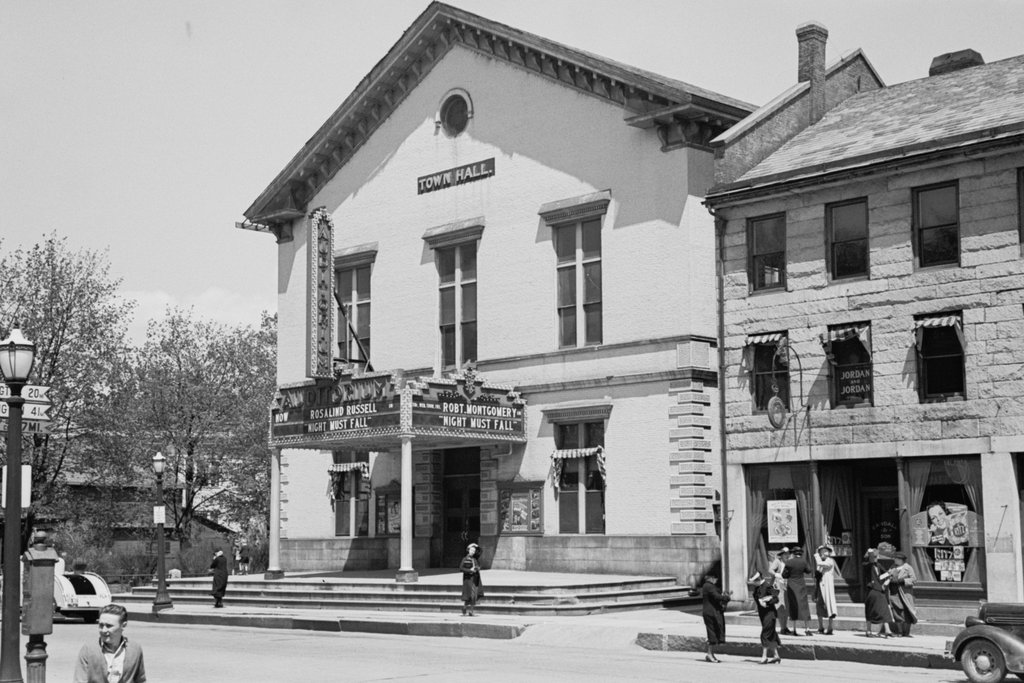
It was in 1882 the Brattleboro Public Library opened on Main Street. The library was located in a room in the Town Hall and was open three days a week for 8 hours a day. A large selection of books, and the knowledge found in their pages, was now available to just about everyone. There had been a privately operated and funded library in town since 1821. This was actually a reading club that was only open to those who could afford membership. The idea of a public library was a clear shift in the thinking of town leaders.
Since 1842 Brattleboro readers have been privileged to borrow books: first, from its early Brattleboro Library Association and 40 years later, when the shareholders offered the books to the town, from the Brattleboro Free Library, which moved in 1887 from its quarters in the lower Town Hall to the George J. Brooks Library.
In 1886, the library received an opportunity to expand when local benefactor George Brooks funded the construction of a new library building. Brooks planned and constructed the library building which was presented to the town and at the time was described as “beautiful and commodious”.
In 1887, a booklet published to explain Brattleboro to others wrote that the community support and extensive use of the library was “another proof of the remarkable intelligence of our people”. At its opening, the collection numbered 5,000 volumes.
By 1912 it was time for an addition to the library. Brattleboro was booming and construction was taking place throughout the town. The Fort Dummer Cotton Mill and Island Park had just been built and the town was growing rapidly.
Mrs. Henrietta Loud offered a $3000 donation towards an addition to the Brooks Library. The town kicked in $2500 and the trustees donated another $2500 for the creation of an addition to the back end of the building.
At the same time, Mrs. Loud also donated a valuable collection of fine art to the library. Through the years the library has been a showcase for artwork, as well as an intellectual hub for the region.
In the 1960’s the library was again at a crossroads. The federal government, needing more space for postal operations on Main Street, negotiated with the library for the purchase of the property at the very time the library’s building had become overcrowded and relocation was necessary. The building was crunched for space and the post office next door wanted to expand. The federal government offered to buy the library site. In a special meeting in 1965, Brattleboro town meeting members voted to issue a bond of $243,000 as the town’s share of the building project. Other funds were raised from the sale of the property, interested community members, and organizations.
The George J. Brooks Library building was torn down, and a new, larger building was constructed farther north on Main Street. Annabelle Pike was part of the transition. Annabelle, an assistant librarian in the 1960s and 1970s remembers, “It’s really too bad that they demolished it. It became a parking lot for the Post Office.”
Annabelle, who graduated from Brattleboro Union High School in 1958, “really liked the building. It was old. I liked it a great deal more than the new one. I still do.”
As a patron, before she was hired to work there, she says, “I used to go in a lot. I spent a lot of time studying there because it was quiet.” Annabelle was a student at Keene State College. After college someone recommended that Annabelle apply for a job at the library. “There was an opening and someone recommended me. I am not an actual librarian. I do not have a degree.” Still, she was hired and became a ‘face’ of the old, and later, the current Brooks Library.
Remembering her employment at the Brooks she recalled summer activities with school children. “During the summer we would have reading contests. How many books can you read during the summer? The youngsters were on the ‘honor system’ to report accurately on the book(s) they returned.”
In answer to the question – what else did the library have to offer besides books, Annabelle’s memory was tested. “We had phonograph records, no, that was in the new library. There was no microfilm.”
Annabelle remembers that most patrons “were very nice. There was one man who wanted a book that wasn’t acceptable. Kids for the most part were good.”
Who ordered books and who paid for them at the old library?
According to Annabelle, “Mrs. Leach ordered books. You filled out a piece of paper with the book’s information. We purchased books from the Book Cellar. We were considered part of the town. We were paid and received medical insurance from the town.”
Annabelle would respond to a friend who recommended a life change and she left the library and went to work at American Stratford on Putney Road.
“Things have changed drastically. At the end of the day we used to pick up all the cards that were pulled out of the back of books and arrange them by author and by the dewey decimal system. We’d know the next morning, these are books that should have been returned and haven’t been.”
“I have no idea how they do it today, probably all by computer.”
The newest library, the George J. Brooks Memorial Library, completed in 1967, has continued the plans of its founder by providing the town with cultural and educational advantages. Gifts of all sizes have enriched the collection and memorial contributions have continued to make possible the purchase of materials on a wider subject range, and in different formats, than the annual town budget could assure. Other funds were raised privately.
The older building’s interior was finished with fine woodwork from around the country. The craftsmanship found in the original Brooks Library was from a different age and is not duplicated in public buildings these days.
The new Brooks Memorial Library opened for business Sept. 25, 1967. On May 13, 1968 Mark Bennett of Cedar Street Extension was the 10,000 person to request a library card since the new card system had been adopted in 1954.