William Brattle portrait

Brattleboro’s Beginnings

ORIGINS: BRATTLEBORO’S BEGINNINGS Abenaki & Fort Dummer Prior to the 1700’s, Vermont was home to the Abenaki.  Fort Dummer was built as the first English settlement in Vermont in 1724. The view of the Connecticut River and Mount Wantastiquet from the former site of Fort Dummer THE FORT Lt. Governor William Dummer of the Massachusetts Bay Colony built Fort Dummer as protection against the Abenaki. The wooden, walled fort was the northern outpost of settlers along the Connecticut River and defended against native and French attacks. In 1728 it became a trading post. It was used until 1750 by troops as a fort when skirmishes broke out. The fort was located just south of Brattleboro in a place now submerged by the Connecticut River. It was located along the river for ease of transportation and because of the ability to watch who was going up and down the river in a strategic fashion. CHARLES C. […]

Continue reading

The Brattleboro Historical Society Annual Meeting 2021

Page 1 Carol Farrington, Sec Brattleboro Historical Society – 2020 Annual Meeting November 15, 2020 – Virtual meeting via ZOOM The annual meeting was held via ZOOM as a result of the Covid Pandemic which has been curtailing most in-person activities. Call to order: 2:00 p. m. The annual meeting of the membership was called to order at 2:00 p.m. by board acting president Joe Rivers, with many of the board members present. Minutes of the November 17, 2019 Annual meeting were read. A motion to approve was made and seconded. Motion approved by voice vote. Financial report for the previous 10 months was available for review. Motion made and seconded to accepted as written. Election of Trustees: Those trustees who were up for re-election had accepted term extension. Motion to accept them was passed by voice vote. The meeting adjourned at 2:06 p.m. “Our guest speaker was Jenna Carroll, the Director of Education at […]

Continue reading
Mary E. Wilkins Freeman

Mary E. Wilkins Freeman

Mary E. Wilkins Freeman – West Brattleboro Mary E. Wilkins Freeman, beloved 19th century American author and Brattleboro local, began her 50-year literary career in Brattleboro. She published over 250 short stories, 14 novels, and 3 plays. Freeman was quite an original. Strong and independent, she was a shrewd business woman as well as a talented writer. She made a fortune writing of New England life and its characters, many of whom rebelled against societal expectations and constraints. Mary E. Wilkins Freeman was internationally known, and America’s most popular woman writer during the late nineteenth century and the first two decades of the twentieth century. She was the first recipient of the prestigious William Dean Howells Gold Medal for Fiction in 1926, was among the first three women elected to the National Institute of Arts and Letters, and in 1938 was memorialized when the American Academy of Arts and Letters installed bronze doors inscribed, “Dedicated […]

Continue reading
Brooks Memorial Library circa 1880s.

William Czar Bradley II & Brooks Memorial Library

William Czar Bradley II, grandson of the famous jurist and poet from Westminster, was the first library director of Brook Memorial Library, serving from 1884 until about 1904. He was class poet at Harvard University, and he published two books in his time. The Brooks Memorial Library still stands today, but in Bradley’s time it looked very different. The “beautiful and commodious” Victorian-style library Bradley knew stood until the 1960s, when it was demolished and the current structure was built in its place.

Continue reading

Wells Fountain

The Fountain Wells Fountain, one of Brattleboro’s best-loved landmarks, stand proudly on the northern edge of its downtown shopping district. Designed in 1890 by Brattleboro architect William Rutherford Mead (cousin to President Rutherford B. Hayes) and funded by William Henry Wells, Brattleboro native and new York businessman; this lovely granite fountain features two fierce lion head medallions on the north and south sides of a large basin. A pair of Corinthian columns supports the large lintel and electric lantern encased in graceful iron scrollwork. The Snow Angel Location Wells Fountain, also known as Wells Drinking Fountain, was built to mark the spot where Mead’s brother Larkin Mead, a nationally known sculptor, created an eight foot Snow Angel on New Year’s Eve 1856. The ephemeral angel caused such a sensation that Larkin later fashioned a marble replica that is currently on view in Brooks Memorial Library. The Move In 1986, the fountain was moved twenty feet […]

Continue reading

Jody Williams

Who is Jody Williams? Jody Williams was awarded the Nobel Peace Prize in 1997 for founding and leading the International Campaign to Ban Landmines, an unprecedented cooperative effort that brought governments, United Nations bodies, the International Committee of the Red Cross and more than 1000 NGOs in 90 countries together to pass the Ottawa (Mine Ban)Treaty. She lived on Western Avenue and Chapin Street growing up, attended the Green Street School from 1957 to 1962, graduated from Brattleboro High School in 1968, attended the University of Vermont, the School for International Training (SIT) and Johns Hopkins University’s School for Advanced International Studies, and lives in the area today. A brave and straight-talking defender of human rights globally, Williams now studies modern warfare to promote new understanding about security today, especially the Campaign to Stop Killer Robots. Nobel Women’s Initiative She helped establish the Nobel Women’s Initiative in 2006 to use the visibility and prestige of […]

Continue reading

History Bits

1958 Vermont’s oldest bank and its largest commercial bank merged to become the Vermont National and Savings Bank. The banks which merged were the Vermont Savings Bank, the oldest savings bank which was organized in 1846, and the Vermont Peoples National Bank of Brattleboro, Vermont’s oldest commercial bank, which was incorporated in 1821.

Continue reading

Indigenous Sites – Wantastegok: The Place of the River Where Things Are Lost

Since long before the advent of writing, right here in the Connecticut River Valley there have lived a people known as the Sokoki Abenaki (or, translated into English from the original Sokwakiak, “The People Who Separated”).

They are the original people of this place, and they are still here. Their native tongue, Aln8ba8dwaw8gan—the Western Abenaki language—is still extant, but greatly endangered.

Continue reading

Snow Removal Equipment – Changes Over Time

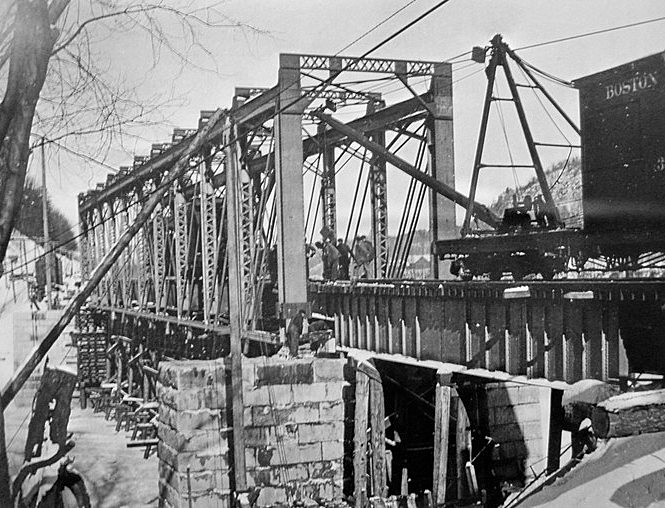
By WAYNE CARHART In New England when people lived mostly on farms, snow removal was limited to clearing a path from the house to the barn if the two buildings were not connected by a series of sheds, as they often were. Most of the occupant’s needs were met within the confines of their house and barn. Food, firewood, and silage had been stored so there was little need to travel over snow-covered roads. After the railroad and streetcars came to Brattleboro, snowplows and teams of men were hired to clear the tracks. No thought was given to actually removing the snow from the roads until after the arrival of the automobile. When roads were paved and people became more dependent on the automobile, the thought of not being able to use it in the snow was simply unacceptable to most citizens. Telegraph and then telephone and electric lines that were felled by a snowstorm […]

Continue reading