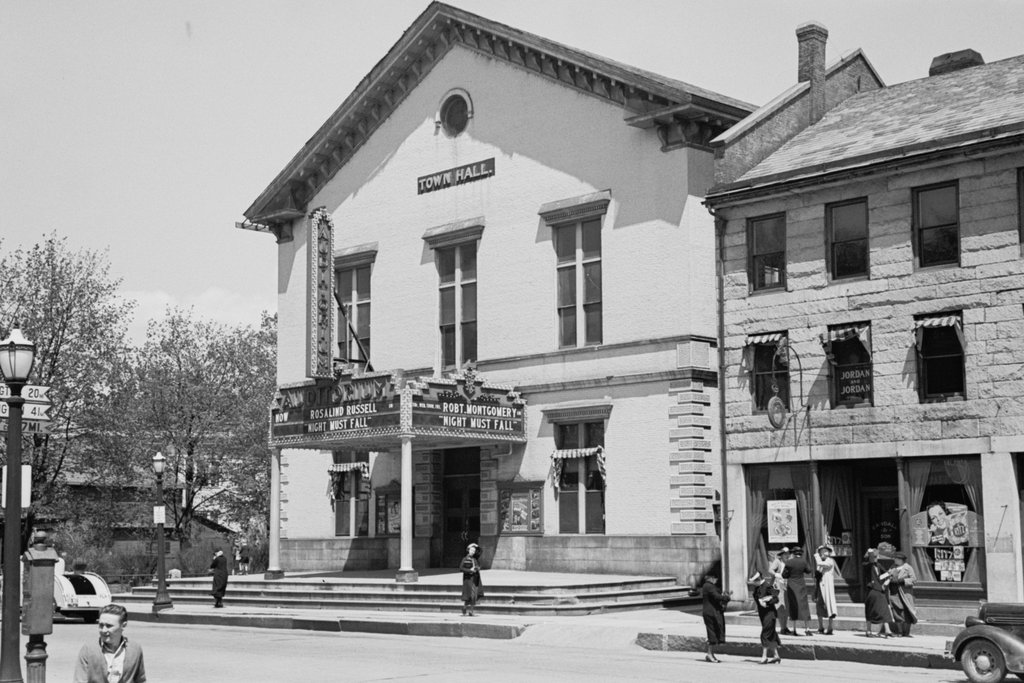
On March 2, 1870 the Boston Post reporter Sallie Joy visited town and wrote “Brattleboro has had a fire and a flood, and now it has a Woman Suffrage Convention. I saw an old farmer yesterday with the inevitable blue woolen frock and cart whip snugly stowed under his arm, reading one of the posters announcing the meeting. Patiently he waded through it, then turned on his heel and wondered aloud, ‘What in the thunder’ll come next.’”
In March of 1870 Brattleboro was less than a year removed from a devastating fire that destroyed the west side of Main Street and a flood that roared down the Whetstone Brook, killing two people and inflicting over $300,000 worth of damage.
The young reporter went on to write that no one was able to tell the old farmer what might happen next, with women pushing for equal rights, but she offered that local women might see it as the Biblical coming of the Millennium…a time when all wrongs would be put right and all evils would be cleansed from the earth.
Sallie Joy was the first female staff reporter hired by a Boston newspaper. Miss Joy was reporting on one of the many Woman Suffrage Conventions that were held in Vermont during the early months of 1870. That year each Vermont County hosted a suffrage convention as a Vermont Constitutional Convention was planned later in the summer and one of the proposed topics was a woman suffrage amendment.
The recently formed American Woman Suffrage Association was leading this series of Vermont suffrage conventions in hopes of stirring up support for the women’s voting rights amendment. Women’s voting rights advocates Lucy Stone, Mary Livermore, Julia Ward Howe, William Lloyd Garrison and Edward Tyler traveled from county to county promoting women’s equality during the conventions.
Also traveling with the convention from town to town was the Boston Post reporter Sallie Joy. She was a native of Brattleboro and this was her first assignment with the paper. She had moved to the Boston area in 1865 and become involved in the women’s suffrage movement.
Sarah Elizabeth “Sallie” Joy was born in 1847. Her parents were Samuel and Rhoda Joy. According to her biography in the Encyclopedia of American Journalism, she grew up in a privileged middle class environment. During her childhood the family moved a few times. The Joy family began in a house on Main Street, where the post office parking lot is now located, then moved to Walnut Street, and eventually to West Brattleboro at the old Hayes Tavern property. Sarah was able to attend local public schools and graduated from the Greenwood Seminary in 1865.
In 1865 Sallie’s father died and she moved to the Boston area to live with family friends and look for a worthwhile job. At first she tried teaching and then became a librarian. Sallie worked at Loring’s Circulating Library. The library was a gathering place for New England intellectuals and Sallie met many influential authors and reformers.
One of the people she met was Mary Livermore, editor of the Woman’s Journal, a women’s rights periodical. Sallie had been writing pieces for the Vermont Record and Farmer and the Home Journal. When her boss increased her hours of work at the library without an increase in her salary Sallie wrote to her mother and said she would leave her job as soon as she was able. She wrote, “I will not be bullied by any man.”
Mary Livermore offered Sallie a job at the Woman’s Journal as Livermore’s assistant and clerk. Seeing her potential, Livermore and others began pressuring the Boston press to hire Sallie as a reporter. In early 1870 the American Woman Suffrage Association, which Mary Livermore led, was planning a series of conventions in Vermont. Sallie wrote her mother, “I wish one of the city papers would give me a chance at Vermont, I know I’d write a good report for them.”
Sallie Joy was hired by the Boston Post to cover the Vermont Suffrage Conventions. The Post then hired her as a full-time staff reporter and sent her to cover suffrage conventions throughout New England and the Mid-Atlantic states. Meanwhile, the attempt to pass an amendment to the Vermont Constitution which would allow women to vote failed by a delegate count of 231 against and 1 in favor.
Joy’s career was a living example of the incremental societal change that occurred between 1870 and the eventual passage of women’s voting rights in 1920. Sallie Joy became a Boston newspaper staff reporter at a time when reporting in that city was a completely male profession. She suffered comments in competing newspapers about her looks, her personality and her writing style. However, she would not be bullied and publications began to acknowledge her skills. One article written about her said, “Miss Joy has one qualification necessary to work upon a daily paper. She is quick, she writes rapidly, her thoughts flow freely, and her pen keeps up the pace.”
Joy’s reporting expanded from women’s rights issues to the struggles of the poor in Boston’s North End. While she was receiving daily assignments from the Boston Post she also supplemented her income by writing for publications like the New York World and the Woman’s Journal.
In 1874 Sallie married Henry White, a singer and musician, and left her position at the Boston Post. Unfortunately Henry White’s musical career proved to be on the decline. In less than a year Sallie began writing again for various publications. During these years Sallie kept in touch with her Brattleboro childhood friends and came back to visit her classmates from Glenwood Seminary. In 1877 the Vermont Phoenix reported that Sallie Joy White was a guest of Abbie Fuller at Pine Heights. Meanwhile, Henry traveled more and more to look for work and eventually, in 1879, the couple separated after the birth of their second daughter.
Sallie’s widowed mother moved to Massachusetts to keep house and care for the two small daughters and Sallie went back to work full-time. She worked for the Boston Advertiser for ten years and then, in 1885 she joined the Boston Herald. She worked for the Boston Herald for the next 21 years.
During these years she became a leader in the effort of New England women to gain equal status in the workplace. She was a founder and President of the New England Women’s Press Association. She founded an organization called the Daughters of Vermont which existed to support Vermont women who had moved to the Boston area for work. Members networked with one another and supported each other in the male-dominated working world of Boston. Sallie also served as secretary of the local chapter of the American Woman Suffrage Association.
Another interest of Sallie’s was the women’s club movement. She joined the New England Women’s Club and became a leader in the organization. A goal of women’s clubs across the country was to change public policy. Sallie became a reform advocate for education, child labor, and women’s rights at home and in the work place. Women could not vote so women’s clubs were organized to give a collective voice for issues that were important to them. Sallie became an officer in the national women’s club movement and attended conferences internationally as well.
During the 1880’s and 1890’s Sallie traveled around the country to give talks at newspaper conventions, suffrage meetings and women’s club conventions. She also began writing books during this time. Her first book focused on women’s work in the home, her second one on the importance of education for young women, and her third book highlighted women’s growing opportunities in the changing workplace of modern society.
Sallie Joy White continued to work as a newspaper reporter and columnist until her death in 1909. She paved the way for female journalists throughout New England. She understood the fight for women’s equality would be fought in the halls of government and the managerial offices of the workplace. Sallie also recognized the power of women working together to gain influence in a male-dominated society. She was an organizer, spokesperson and pragmatic leader in the fight for women’s rights. Through it all, she raised her daughters, looked after her mother, and held a full time job while serving as a role model for other women who wanted more opportunity in their lives.
Much of the information was found in a paper titled Pioneering for Women Journalists: Sallie Joy White 1870-1909 written by Dr. Elizabeth Bert, from the University of Hartford.