In June, 1956 Eleanor Roosevelt traveled from Hyde Park, New York to Putney, Vermont in order to give the commencement address for the Putney School. Mrs. Roosevelt wrote in her daily newspaper column that the road to Putney “goes through the mountainous countryside-not very high mountains, but friendly, small ones-heavily wooded, with many streams rushing down beside the road, and every now and then a beautiful lake.”
Forty nine students graduated from Putney School that year. They came from ten different states, the District of Columbia and three foreign countries. Mrs. Roosevelt had agreed to give the commencement speech because, over the years, many people in her circle of friends had sent their children to Putney.
In her speech she asked graduates to reflect on the experiences they had at the Putney School. She said the modern world left little time for going through life without a purpose and she explained that young people should use what they learned at the school to help shape their purpose in life.
As a relentless supporter of human rights Mrs. Roosevelt then pivoted to the challenge of racial integration in the United States. This was the time of Rosa Parks and the Montgomery Bus Boycott. In Clinton, Tennessee twelve African American students had registered to attend the all-white Clinton High School in the fall. Racial tensions were high in many parts of the country and Mrs. Roosevelt brought up the “integration problem” in her speech. She pointed out to the graduation crowd that the world is “two thirds colored”. She said the world was watching how the United States proceeded with racial integration and would pass judgment on how well the country responded to the challenge.
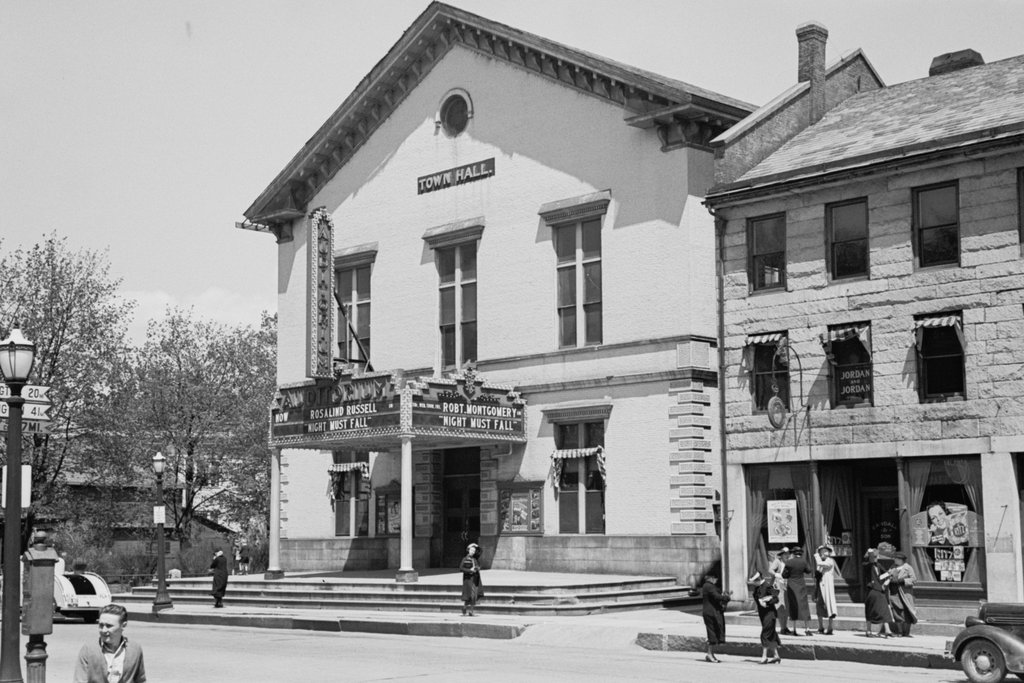
After the graduation ceremony Mrs. Roosevelt traveled to Brattleboro and stayed at the Brooks House for the night. This was not her first visit to the Brooks House. In 1945 she visited what was then known as the Hotel Brooks for breakfast. She had taken the overnight train from Washington DC and arrived at the Brattleboro train station on April 10. Mrs. Roosevelt was on her way to Chester, Vermont for a high school ceremony and was then traveling to Keene to stay with friends.
When Mrs. Roosevelt arrived in Brattleboro there were two motion picture cameras filming her departure from the train. She was driven from the station by her Keene hosts and they motored to the Colonial Room of the Hotel Brooks for breakfast. At the time, Mrs. Roosevelt was the First Lady of the United States and was traveling with her secretary Miss Malvina Thompson.
Miss Betty Sebert was the waitress who served Mrs. Roosevelt breakfast. She reported that “Mrs. Roosevelt was very pleasant and commented on the excellent service.” The flowers on the Colonial Room breakfast table were mayflowers, the party each took a few sprigs and pinned them in their buttonholes to celebrate the early spring day.
That morning there had been no official welcome at the train station but by the time breakfast was completed the Main Street sidewalks were lined with a good sized crowd who had heard the First Lady was in town. Mrs. Roosevelt walked from the restaurant to a waiting car but stopped to visit with two little girls, three and a half year old Betty Paulman of Estey Street, and her five year old cousin, Joyce Smith. The girls were accompanied by their mothers and grandmother, Mrs. Maybelle Smith.
Mrs. Roosevelt then traveled to Chester to visit with a high school class that wanted to donate to the war effort and, afterwards, motored to Keene and gave a speech at Keene State Teachers College on the value of education throughout the world. She stayed in Keene for the night, spoke to Keene public school students the next morning and then took a train back to Washington DC. She arrived home at the White House around midnight.
The next day, April 12, 1945 Mrs. Roosevelt was attending a luncheon in Washington when she was given information that her husband, the President, had suffered a stroke in Warm Springs, Georgia. She traveled back to the White House. It was there she was informed that the President had died. Harry Truman, the Vice President was called, and Mrs. Roosevelt met him at the White House. When Truman asked what he could do for Mrs. Roosevelt, she replied, “Is there anything we can do for you? You are the one in trouble now.” Within minutes Harry Truman was sworn into office by Chief Justice Harlan Stone, who had been born in nearby Chesterfield, New Hampshire.
Back in 1956, when Mrs. Roosevelt stayed at the Brooks House, racial tensions were growing in the United States. In the fall of 1956 the twelve African American students Mrs. Roosevelt had alluded to in her Putney School Commencement Speech attended the all-white school in Clinton, Tennessee. An organization known as the White Citizens Council rallied 1,500 protesters opposed to desegregation. A riot began over Labor Day weekend. Cars were overturned and business windows were smashed. The Tennessee Governor had to call out the National Guard to restore order.
Racial strife continued in Clinton, Tennessee. In 1958 the Clinton High School was bombed by segregationists and forced to close. In her daily column, Mrs. Roosevelt had shifted her focus to the “Little Rock situation”. In Little Rock, Arkansas recent efforts to desegregate the local high school had resulted in the President of the United States, Dwight Eisenhower, deciding to send in federal troops to escort the first African Americans into the all-white high school. Mrs. Roosevelt publicized a fundraiser for the NAACP “to pay legal fees in connection with the battle being waged on integration in the schools”. Mrs. Roosevelt continued to advocate and organize for racial integration and equity throughout her life.