George Washington was born in 1732. He was the first President of the United States, leader of the Continental Army during the American Revolution and presided over the Constitutional Convention in Philadelphia. He certainly was a great influence on the founding and formation of the United States.
While researching the life of Brattleboro’s Susannah Bradshaw we came across references about George Washington in newspaper articles from the 1840’s. Susannah Bradshaw was an infant when her parents moved to Brattleboro in 1823. At the time, the Bradshaw’s were the only African American family living in town. The 1820 census shows that there were 2027 residents in Brattleboro. Three of the people listed in the census were African American servants who worked for two prominent families. Each of them lived with the family they worked for. There were no African American families recorded in the census before the Bradshaw’s arrived.
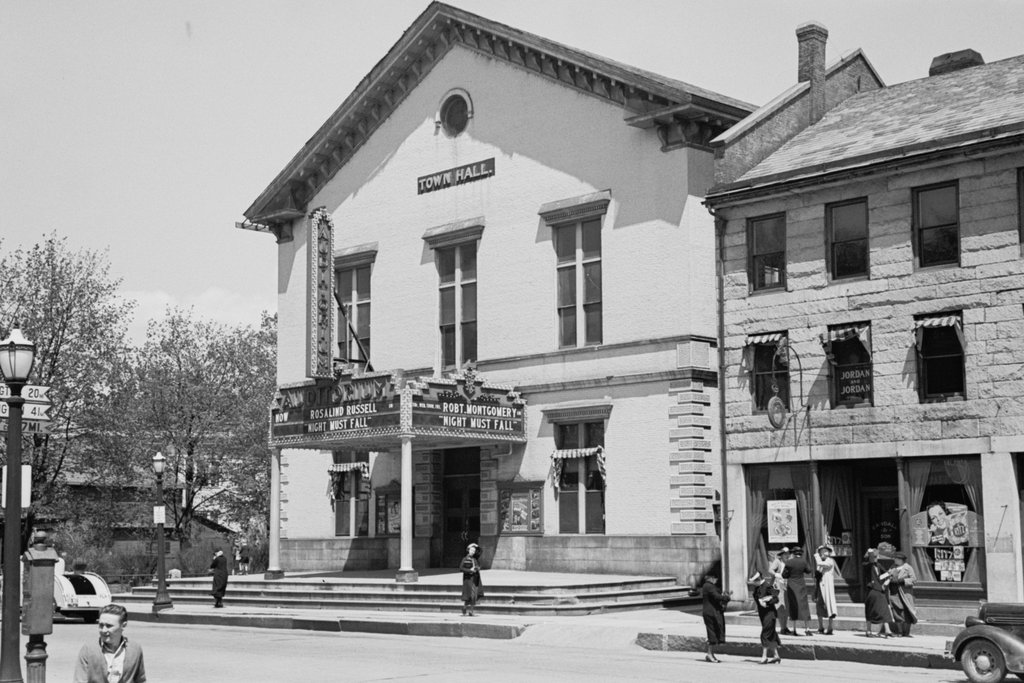
The Bradshaw’s first rented, and later purchased, a small wooden building on Main Street as a home and workplace. Andrew Bradshaw, Susannah’s father, set up a barber shop and garment cleaning business. Susannah’s mother, Phoebe Bradshaw, opened a restaurant and catering business. This building was located where Zephyr Designs is presently. The Bradshaw’s would live in Brattleboro for twenty years.
Susannah grew up in town and attended the Newbury Seminary in Newbury, Vermont. The seminary was a boarding school established in 1834. According to information published by the private high school, the goal of the institution was “to confer a substantial English education, as well as to give instruction in the modern languages so far as is necessary to prepare the student for admission to college.” Susannah’s parents worked hard, saved, and provided a rigorous boarding school education for their daughter.
When Susannah was twenty one years old she married Charles Balfour. The wedding took place in Brattleboro and Balfour was originally from Montego Bay, Jamaica. The marriage news was published in the Boston abolitionist newspaper called The Liberator and the newly married couple moved to Boston to begin a new life together.
Susannah’s father had died the year before so Mrs. Bradshaw sold her property and moved to Boston to live with her daughter and new husband as well. Unfortunately, the next bit of information we could find about Susannah was the announcement of her death in 1848. She was twenty five years old and the Vermont Phoenix reported that she died while living in Boston with her husband.
It was while doing this research that we came upon the reference to George Washington in the Middlebury newspaper, The Vermont Observer. The attention-getting headline proclaimed “Washington’s Runaway Slave”. The article went on to summarize the life of Ona Mariah Judge Staines. It turns out that Ona Staines and Susannah Bradshaw both died in 1848. However, there is a stark contrast between their two lives. One lived enslaved with the President of the United States while the other lived a free life in New England.
Ona was born in 1773. She was the daughter of Betty, an African American skilled seamstress owned by Martha Washington’s family and Andrew Judge, an English tailor who was contracted to George Washington as an indentured servant for twelve years. When Ona was about ten years old she was brought into the Washington household and took on the role of body servant to Mrs. Washington.
While Washington served as President of the United States he first lived in New York City and then Philadelphia, Pennsylvania. In both households he brought enslaved people from his Virginia plantation to serve his family’s needs in the President’s House. Pennsylvania had passed a law to gradually abolish slavery in 1780. According to the law anyone held as a slave in Pennsylvania for more than six months could be granted their freedom. In order to subvert the law Washington had his enslaved workers brought across state lines every six months to make sure they did not gain their freedom while working for his family in the President’s House.
In March, 1796 one of Martha Washington’s granddaughters was married. George Washington invited the newly married couple to visit Philadelphia and stay at the President’s House. Martha Washington told Ona that she was to be given to the granddaughter as a wedding present. As an enslaved person Ona was considered the property of Martha Washington’s family. Ona had no say in this decision.
In May, 1796 Ona ran away from the Presidential House and the Washington’s. She had made friends with free African Americans in Philadelphia and they hid her until she could find a ship’s passage to New Hampshire. The Washington’s had called Ona by her childhood nickname, “Oney”.
On May 23, 1796 the following posting was placed in a Philadelphia newspaper…
Absconded from the household of the President of the United States, Oney Judge, a light mulatto girl, much freckled, with very black eyes and bushy black hair. She is of middle stature, slender and delicately formed, about 20 years of age…Ten dollars will be paid to any person who will bring her home.
Ona found transportation to New Hampshire on a boat called the Nancy. Ona may have thought she would be free once she made it to New Hampshire because the state had legally ended slavery in 1783. However, after only a few months in Portsmouth Ona was unlucky enough to be seen by a friend of one of Martha Washington’s granddaughters. The news was reported to Washington and he contacted a government official in Portsmouth. Washington requested the official track down Ona and convince her to return to Philadelphia. Ona told the official “she would rather suffer death than return to slavery and be liable to be sold or given to any other person.” She also told the official that she ran away from the Washington’s because she had “a thirst for complete freedom.”
George Washington had signed the Fugitive Slave Law in 1793. It gave slave owners the legal right to recapture enslaved people who escaped across state lines, if necessary with force. In Ona’s case Washington was still President of the United States and did not want to violently force her to return to Philadelphia because it might prove controversial. He told the government official to attempt to capture Ona but only if it would not “excite a mob or riot” by abolitionists. Ona remained free.
In 1797 Ona married Jack Staines, a free African American sailor. The couple would have three children. In August, 1799, a few months before his death, Washington attempted to find and capture Ona one more time. A nephew of Martha Washington’s traveled to NH on business and George Washington told him to capture Ona and her infant daughter and bring them back to Philadelphia. Washington was no longer President so this time his instructions said it was alright to use force while bringing Ona and her daughter back to Virginia.
Upon his arrival in NH, Washington’s nephew told people why he was there. Words of warning were passed on to Ona so she traveled to a town eight miles away and hid with another African American family. Even though Washington’s nephew was told to bring Ona and her daughter back by force he was not able to find anyone who would help him.
Ona continued to live the life of a runaway slave. The Fugitive Slave Law meant that Ona and her children were legally the property of Martha Washington’s family and could be captured at any time. After George Washington died Ona was no longer pursued by slave catchers.
In 1845 Ona was interviewed by a Concord, NH newspaper and asked if she was sorry she had left the Washington’s. Her life of freedom had been hard. Her husband died in 1803 and she could not afford to raise her children on her own. Ona used her sewing skills to earn a meager wage but she moved in with another African American family in order to survive. Her two daughters became indentured servants and her son went to sea at a young age. In her later years she was listed as a “pauper” on the town role and received support from the local government. Ona was asked if she thought she had made the right decision to run away from the Washington’s. She said her freedom, her chance to learn to read, and her opportunity to join a religion of her own choice were reasons why her escape was worth the hardship. Ona died in 1848, the same year that Susannah Bradshaw passed away in Boston.
George Washington’s relationship with human bondage was complicated. Some historians claim that Washington became disillusioned with slavery after the Revolution. In 2018 an Associate Curator at Mount Vernon was asked, if that was the case, why he didn’t free the more than 100 people he personally held in bondage. Her response was, “Washington knew he would have to find another way to operate his plantation and another way to provide income for himself and his family. That might have necessitated really changing the way that he lived and potentially sacrificing a lifestyle that he had become accustomed to. So Washington, as he is considering freeing his slaves, doesn’t seem to be willing to make a huge financial sacrifice in order to do so…He would have had to come up with some way to get the money to finance an emancipation, and he did look into several ways of doing that by the renting or selling of some of his land, but he wasn’t able to find a solution that he really found acceptable…Ultimately Washington chose to free his slaves in his will where he put a provision that would emancipate them at Martha’s death. Waiting until after both he and his wife died solved his financial issue.”